


SB 54 Is Published. The Compliance Clock Is Running. Is Your Packaging Data Ready for Audit?


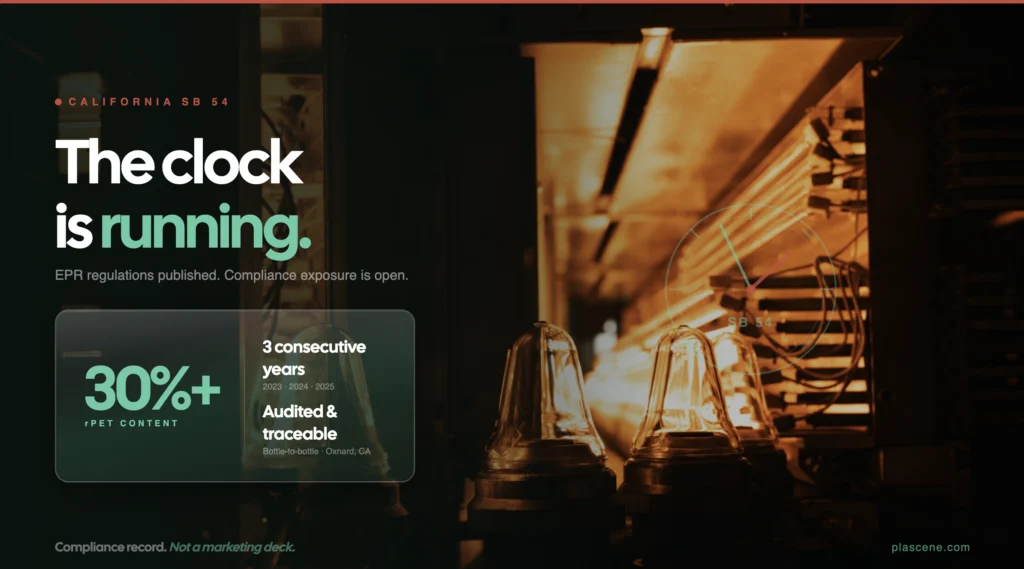
California’s SB 54 EPR regulations are now published, and the exposure window for CPG brands selling into the state is open. Recycled-content readiness is no longer a future planning item — it’s a present audit requirement. Here’s what that means for your packaging supply chain documentation.
California’s Senate Bill 54 has moved from policy discussion to published regulation. For CPG brands selling into the state, the compliance clock started the moment the rules were finalized. The question is no longer whether SB 54 will affect your packaging strategy. It’s whether your current supply chain can produce the documentation to prove compliance when the audit arrives.
This is the part that catches brands off guard. The regulation itself isn’t a surprise — SB 54 has been in development for years. What is a surprise, for many, is how much of the compliance burden falls on verifiable data rather than good intentions.
What SB 54 Actually Requires From Your Packaging
The core of SB 54’s recycled-content provisions is straightforward: brands selling packaged goods into California need to demonstrate that their packaging meets specific recycled-content thresholds, and that the data supporting those claims is auditable.
“Auditable” is the key word. A supplier telling you that your bottles contain recycled content isn’t sufficient. The regulation requires documented proof — chain-of-custody records, verified recycled-content percentages, and supply chain provenance that can withstand scrutiny from CalRecycle or a third-party auditor.
For brands that have been treating recycled content as a marketing claim rather than an operational specification, SB 54 changes the equation entirely. The marketing claim now needs a compliance file behind it.
The Highest-Risk Period This Regulation Has Produced
The window between regulation publication and first enforcement is the highest-risk period SB 54 has created — and it’s open right now.
Brands without audited packaging data are exposed. Brands without documented recycled-content percentages are exposed. Brands whose suppliers cannot produce verified supply chain provenance on request are exposed.
The risk isn’t theoretical. California has demonstrated willingness to enforce packaging regulations, and the SB 54 framework includes reporting obligations that will surface gaps in documentation well before any penalty phase. The brands that discover their packaging data isn’t audit-ready during a reporting cycle — rather than before it — will be managing a compliance problem under time pressure, with limited options.
Why Most Suppliers Can’t Produce What SB 54 Demands
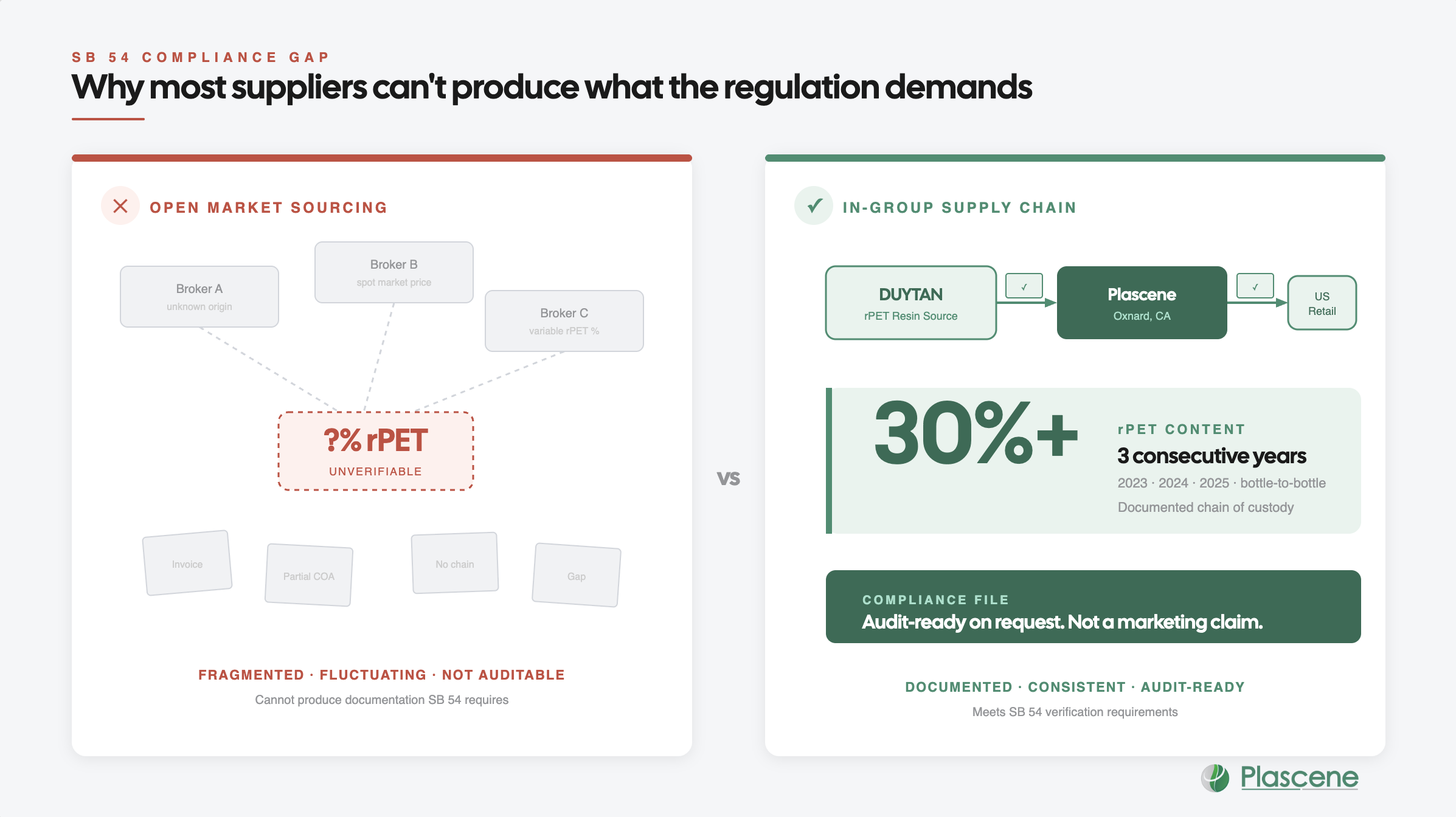
Here’s the structural problem most CPG brands will encounter: their current packaging supplier purchases recycled resin on the open market.
Open-market resin purchasing means the recycled-content percentage in any given production run is a function of what was available and affordable at the time of purchase. It fluctuates. The documentation is fragmented across multiple brokers and intermediaries. The chain of custody is difficult to reconstruct, and nearly impossible to verify to the standard SB 54 requires.
This isn’t a criticism of open-market suppliers. It’s a description of how the market works. The problem is that SB 54 doesn’t accommodate that reality. The regulation requires consistent, verifiable, documented recycled content — exactly the kind of data that open-market sourcing structures struggle to produce.
What Audit-Ready Recycled Content Actually Looks Like
Plascene has maintained over 30% rPET content across its product base for three consecutive years — 2023, 2024, and 2025. That content is sourced through bottle-to-bottle recycling operations with a documented chain of custody, originating from DUYTAN Recycling and feeding into Plascene’s manufacturing facility in Oxnard, California.
That’s the kind of record that belongs in a compliance file, not a marketing deck.
The distinction matters because SB 54 compliance isn’t about what percentage a supplier claims. It’s about what percentage a supplier can prove — with documentation that traces the recycled material from source to finished package, through every step of the supply chain.
For brands evaluating whether their current packaging partner can support SB 54 reporting, the test is simple: ask your supplier for audited recycled-content data. If they can hand it to you on request, you’re in a defensible position. If they can’t, that gap will surface in your SB 54 reporting obligations before it shows up anywhere else.
The Documentation Question Every Brand Should Be Asking
SB 54 has shifted the packaging conversation from “what percentage of recycled content do you offer?” to “can you prove it?”
That shift favors suppliers with structural control over their recycled-content supply chain — suppliers who don’t depend on spot-market resin purchases to meet recycled-content commitments, and who maintain chain-of-custody documentation as a standard part of their manufacturing process rather than a special request.
The brands that will navigate SB 54 smoothly are the ones asking the right question now, before the first reporting deadline arrives: What does your packaging supply chain documentation look like today?
Explore Plascene’s rPET packaging solutions and supply chain documentation at plascene.com.


SupplySide Global 2026 – Let’s build packaging that’s ready for 2027

PET Cosmetic Bottles: When Shape Meets Function Across the Beauty Shelf
