


Mono-Material Packaging: A Clear Path Through the New Era of U.S. Packaging Rules
For years, mono-material packaging sat in the “nice to have” column of brand sustainability plans. On May 1, 2026, it moved to the front of the roadmap.
That is the day California’s Office of Administrative Law approved the permanent regulations for SB 54 — the Plastic Pollution Prevention and Packaging Producer Responsibility Act. The rules are now in effect, the Producer Responsibility Organization plan has been submitted, and the program officially launches January 1, 2027.
For many brands, this is a lot to absorb at once. The good news: the path forward is clearer than it looks — and the format best positioned to carry you through it is one the recycling system already knows well. You don’t have to navigate this alone.
What mono-material packaging actually means
Mono-material packaging is built from a single polymer family — an all-PET bottle with a compatible closure and label system, an all-PP tub, a mono-PE film — rather than fused layers of incompatible materials. The distinction matters because recycling infrastructure sorts by resin. A PET bottle with a PVC shrink sleeve or a metallized multilayer laminate can’t be cleanly reclaimed; it gets downgraded, rejected, or landfilled.
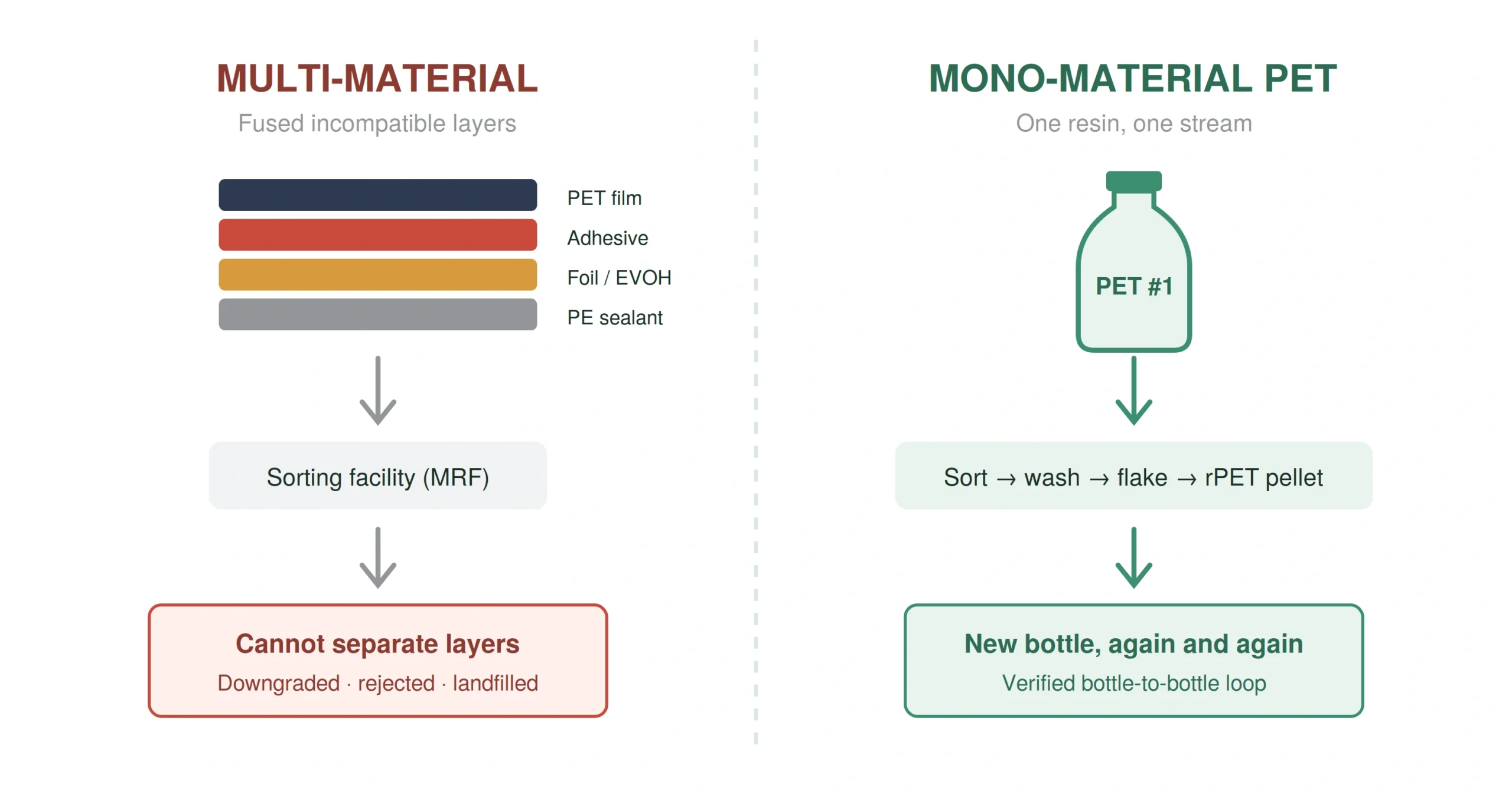
Under the new framework, that difference now shows up in practical places: your recyclability classification, your program fees, and how smoothly your products move through the largest consumer market in the country. Understanding it early makes every later decision easier.
The numbers behind SB 54 — and why 2026 is the pivot year
California’s law sets three hard targets for 2032: 100% of covered single-use packaging must be recyclable or compostable; a 65% recycling rate, measured per individual plastic category rather than across plastics broadly; and a 25% source reduction in single-use plastic versus 2023 levels, with interim targets of 10% by 2027 and 20% by 2030.
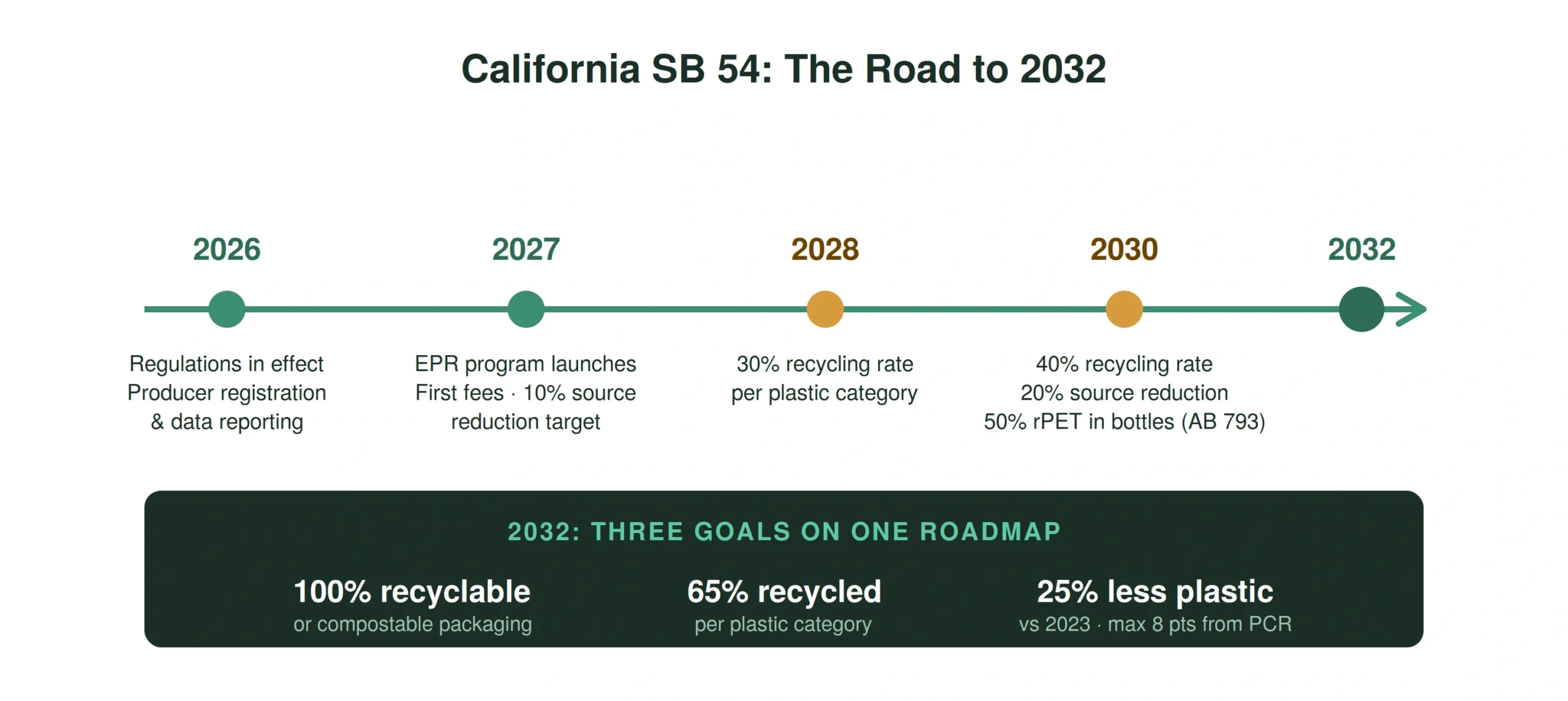
Two details in the regulations deserve every packaging director’s attention.
First, the 65% recycling rate applies to each covered material category separately. Formats that already struggle in recovery systems — multilayer films, heavily pigmented containers, mixed-material structures — face the steepest climb, because there is no averaging against high-performing formats.
Second, the source reduction rules cap the contribution of recycled content: no more than 8 percentage points of the 25% reduction can come from increased PCR, and only PCR added above 2023 baselines counts — validated through APR’s Postconsumer Resin Certification program. In other words, recycled content alone won’t carry the target — thoughtful package redesign is part of the journey. The encouraging part: for rigid PET, most of that redesign playbook already exists.
The law does carry real weight — CalRecycle can impose administrative civil penalties of up to $50,000 per day, per violation. And with seven U.S. states now operating packaging EPR laws — including Oregon and Colorado, with Minnesota, Washington, and Maryland moving through registration — there’s a genuinely helpful pattern: the data foundation you build for California becomes your foundation everywhere else. One well-planned effort serves the whole map.
Why rigid PET is the strongest mono-material starting point
Here is the part of the mono-material conversation that often gets lost in discussions about films and pouches: the PET bottle is the most proven mono-material format in the U.S. recycling system.
PET (#1 resin) is accepted in virtually every U.S. curbside program. According to NAPCOR’s 2024 PET Recycling Report — the 30th annual edition and the industry’s definitive dataset — the U.S. PET bottle recycling rate stood at 30.2% in 2024, above the prior decade’s average, while North American collection reached 39.2%, well beyond the Ellen MacArthur Foundation’s 30% benchmark proving that recycling “works in practice and at scale.” No other plastic packaging format comes close.
Just as important: bottles remain the dominant end market for rPET, accounting for more than 60% of all recycled PET sold domestically. That means a properly designed PET bottle doesn’t just get collected — it gets remade into another bottle. This is the bottle-to-bottle loop regulators are trying to engineer for every other format, and it already exists for rigid PET.
California reinforces this loop with AB 793’s recycled content mandates: PET beverage bottles must contain 25% rPET today, rising to 50% by 2030. Securing certified, traceable rPET supply early — ideally through a vertically integrated partner who controls the loop from collection to finished container — turns that escalation from a future risk into a simple planning item on this year’s calendar.
Designing PET packaging that actually passes recyclability review
“Mono-material” is a design discipline, not a resin choice. A PET container can still fail recyclability screening if the supporting components sabotage the stream. The details that determine whether your package clears APR Design Guide criteria include:
- Closures and liners: PP or HDPE caps are tolerated because they float-separate in the wash process; metal or thermoset closures are not.
- Labels and sleeves: Full-body PVC or PETG shrink sleeves can contaminate the PET flake stream or cause bottles to be missorted. Floatable, wash-off compatible label systems preserve recyclability.
- Colorants and additives: Heavily pigmented or opaque PET drops flake value and can trigger the “non-clear” penalty in eco-modulated fee structures.
- Barrier strategies: Where oxygen or UV protection is required, monolayer barrier additives and coatings compatible with PET reclamation beat multilayer co-injection structures that complicate recovery.
These are decisions made at the design-for-manufacturing stage — which is exactly why the most productive supplier relationships today look less like purchasing and more like co-planning, with your packaging partner at the table from the first sketch.
Planning your transition: the next 12–18 months
The compliance mechanics are accelerating through 2026: producer registration, SKU-level packaging data reporting, source reduction plans, and the first program fees arriving in 2027. Packaging redesign cycles for most brands run three to five years. Mapping those two timelines together simply means the planning conversations worth having are the ones happening now — calmly, with room to test and iterate, rather than later under time pressure.
Here’s the sequence we walk through with brands:
- Audit your portfolio by covered material category and flag every format at risk of failing recyclability classification.
- Prioritize conversions to proven mono-material formats — rigid PET and rPET first, where recycling infrastructure, end markets, and PCR supply already exist at scale.
- Lock in certified rPET supply with full traceability, because recycled content claims under SB 54 must be documented, not asserted.
- Choose manufacturing partners who own their supply chain, from resin to finished container, so your material data survives an audit.
The bottom line
Mono-material packaging is becoming a priority because the rules — and increasingly your customers — are asking for it. For brands selling into California and the growing group of EPR states, the most reliable path forward runs through the one format that has already proven circularity at scale: recyclable PET, increasingly made from certified rPET, in a verified bottle-to-bottle loop.
The transition takes planning, but it doesn’t have to be overwhelming. With a packaging partner who owns its supply chain, certifies its rPET, and prepared for EPR long before it arrived, the next five years become an opportunity to lead — together.


