


Why Child-Resistant Caps Are Hard to Open, and Why That’s the Point


Everyone has stood at a kitchen counter pressing down and turning a pill bottle cap that refuses to move. Child-resistant caps are built to do exactly that.
Here is what most people never learn. That difficulty is not a side effect of the design. It is the specification, and it was measured on real children and real older adults, under a test protocol written into U.S. federal regulation.
Once you know how child-resistant caps are tested, a lot of pharmaceutical and supplement packaging starts to make sense.
How child-resistant caps are tested: 2 panels of real people
The U.S. protocol for child-resistant packaging, 16 CFR 1700.20, puts a package in front of 2 groups of testers who want opposite things from it.
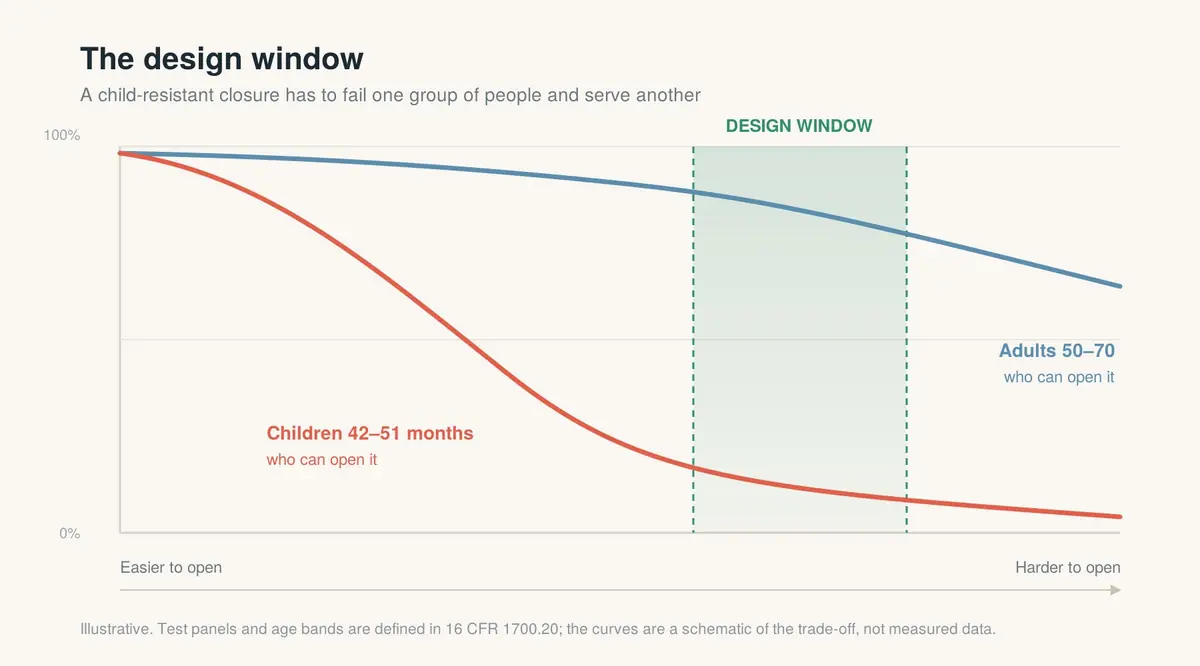
The children come first. Panels of 50 at a time, up to 200 in total, aged 42 to 51 months. That is roughly 3½ to 4¼ years old. The age mix is fixed: 30% at 42 to 44 months, 40% at 45 to 48 months, 30% at 49 to 51 months. Each child gets 2 periods of 5 minutes, 10 minutes in all. The regulation sets exactly how many may succeed before the package fails.
Then come the older adults. A panel of 100, aged 50 to 70, with its own fixed spread: a quarter aged 50 to 54, a quarter 55 to 59, and half aged 60 to 70. Each has up to 5 minutes to open and close the package, then a second package to open and properly resecure within 1 minute.
That second panel is the part almost nobody knows about, and it is the more interesting half. Designing a cap that defeats a 4-year-old is trivial. Weld it shut. The regulation does not allow that. The same package has to be opened, and correctly closed again, by someone in their late sixties, under time pressure, on camera.
How the child-resistant caps test actually runs
| Child panel | Senior adult panel | |
|---|---|---|
| Who | Up to 200 children, in groups of 50, aged 42 to 51 months | 100 adults aged 50 to 70, tested one at a time |
| Age mix | 30% / 40% / 30% across 3 bands | 25% / 25% / 50% across 3 bands |
| Time | 2 periods of 5 minutes, 10 minutes total | 5 minutes to open and close, then 1 minute to open and resecure a second package |
| Objective | Must not get in | Must get in, and close it again |
The same package has to fail one stopwatch and pass the other. The design target is a narrow window between 2 populations whose hand strength and dexterity overlap more than you would expect.
Child-resistant caps are a trade-off, not a feature
From those 2 panels, 3 things follow, and all 3 matter to anyone specifying a package.
Child resistance belongs to the whole package, not the cap. The protocol tests a closed package: container, closure and liner together. A bottle on its own is not child-resistant. A bottle with a particular closure and liner, tested as a unit, either passes or it does not. Swap the liner or change the neck finish and the result can change. A supplier can tell you the thread finish is a standard platform. Only testing on the finished package answers the actual question.
Every gain on one panel costs you on the other. Make the push-and-turn stiffer and fewer children get in. So do fewer 68-year-olds. The engineering work is not making the cap hard. It is finding the window where one population is reliably excluded and the other is reliably not. That window is narrow, which is why child-resistant caps have converged on a handful of mechanisms instead of multiplying.
Usability is a safety outcome. When a package is too hard for the person who actually needs the medicine, the workaround is to leave it open on the counter, or to decant into something unlabelled. Both defeat the purpose. The senior adult panel exists because a package that only passes the child test is not a safe package.
What this means if you are specifying packaging
For a brand or a contract packer buying child-resistant caps, the takeaways are short.
Treat child resistance as a property of a tested combination, and ask for the test report on the exact container, closure and liner you intend to ship. Remember that a change you think of as cosmetic, a different liner or a slightly different neck, may put you outside the tested configuration. And ask the usability question alongside the safety question: who opens this every day, and can they close it again properly?
If you are sourcing PET jars for supplements and OTC products, start the closure conversation at the same time as the bottle conversation. The 2 are tested together, so they should be chosen together.
The next time one of these child-resistant caps fights back, it is worth remembering what it is doing. It sits inside a window defined by 2 panels of real people, one of whom it must keep out and one of whom it must let in.



SupplySide Global 2026 – Let’s build packaging that’s ready for 2027

PET Cosmetic Bottles: When Shape Meets Function Across the Beauty Shelf
